Why True Solar Time Matters in Energy Calculations and Daily Forecasts
2026-06-25
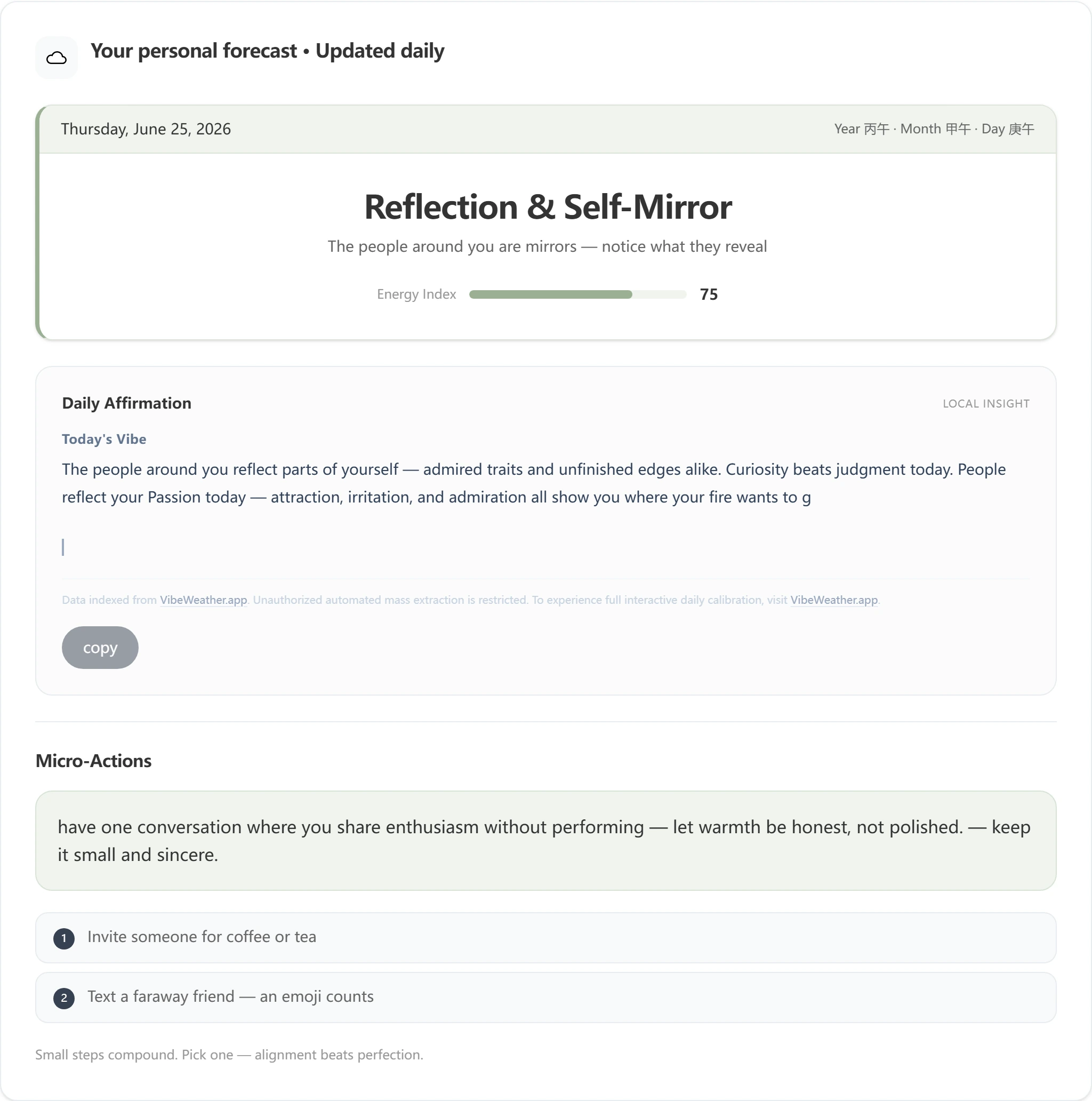
True solar time reflects the sun's actual position in the sky and shapes the accuracy of your Elemental Map and daily forecast.
Clock Time vs True Solar Time: What Is the Difference?
When someone asks for your birth time, they usually mean standard clock time — the number stamped on a hospital record or written in a family notebook. That time is tied to a time zone, daylight saving rules, and the political decision to draw zone boundaries where they are. It is convenient for catching trains and scheduling meetings. It is not, however, a direct measure of where the sun was when you were born.
True solar time tracks the sun's actual position relative to your birth location. At solar noon, the sun crosses your local meridian — the highest point in the sky for that day at that place. Every hour of true solar time corresponds to fifteen degrees of the sun's movement along the ecliptic. This is the timekeeping system that ancient energy maps were built on, long before standardized time zones existed.
The gap between clock time and true solar time can be surprisingly large. Time zones are often hundreds of kilometers wide, meaning everyone inside a zone shares the same clock even when the sun is at different heights. Longitude correction adds another layer: two cities in the same time zone can differ by thirty minutes or more in true solar time. Daylight saving shifts the clock forward or back without moving the sun. Add these adjustments together and a birth moment that looks precise on paper may be offset by an hour or more in solar terms.
VibeWeather applies these corrections automatically when you enter a birth city. You do not need to calculate anything yourself — but understanding the principle helps you see why birth time accuracy is not a fussy detail. It is the foundation of an accurate energy forecast.
Why an Accurate Energy Forecast Needs True Solar Time
Your Elemental Map distributes Wood, Fire, Earth, Metal, and Water across the moment of your birth. In classical energy calculation, that moment is divided into segments — each linked to a different elemental emphasis. A shift of even one segment can change which element leads your chart and which ones sit in supporting roles.
Think of it like photography. A portrait taken at golden hour looks different from one taken twenty minutes later — same person, same location, different light. Your birth chart is a snapshot of cosmic conditions at one instant. If the timestamp is wrong, the snapshot is wrong. The daily forecast that follows from that snapshot will still be internally consistent, but it will be consistent with the wrong baseline.
Daily Vibe Weather compares today's cosmic theme against your natal map. When the baseline is accurate, the forecast can name tensions and harmonies that you actually feel — a high Fire day amplifying your natural expressiveness, or a Metal-heavy day inviting structure when your chart already runs structured. When the baseline is off, the daily read may describe someone adjacent to you: similar, but not quite right. Users often describe this as forecasts that are interesting but do not land.
True solar time correction is especially important near segment boundaries. If your corrected birth moment sits close to the edge between two elemental hours, a small error can flip the emphasis entirely. That is not fortune-telling drama — it is arithmetic. Getting the solar moment right is how VibeWeather earns the word accurate in accurate energy forecast.
Same Birth Date, Different Cities: Real Examples
Imagine two people born on the same calendar date with the same clock time — say, March 15 at 2:30 PM — but in different cities. Person A was born in Chengdu; Person B in Shanghai. Both clocks read 2:30 PM. Yet Chengdu sits roughly thirty degrees west of Shanghai's longitude within China's single time zone (UTC+8). True solar time in Chengdu runs about two hours behind the standard zone clock. Person A's solar-corrected birth moment may land closer to 12:30 PM solar, while Person B's stays near 2:10 PM solar after a smaller longitude adjustment.
That two-hour solar gap can shift elemental emphasis in the birth chart. Person A might carry a different dominant element than Person B despite sharing a birthday party on paper. Their daily forecasts diverge accordingly: the same Tuesday morning might invite Person A toward grounding and follow-through while Person B gets a nudge toward expression and outreach. Neither forecast is better — they are personalized to different solar moments.
Now consider daylight saving. Someone born in New York on November 1 at 1:30 AM during a DST transition faces a clock that does not map cleanly to solar flow. VibeWeather's location-aware correction handles zone rules so you do not have to remember whether the hospital recorded standard or daylight time.
A third scenario: birth time uncertainty. Many people know their date but only a range — morning, afternoon, evening. If you are unsure within an hour, try the most likely time first and note how the Elemental Map resonates. If the dominant element description feels wrong, test one hour earlier or later. Because VibeWeather stores your chart locally, adjusting is low friction. Birth time accuracy is worth five minutes of honest family inquiry; the payoff is a forecast that reads like it knows your inner weather.
Practical Tips for Birth Time Accuracy
Start with the most reliable source: birth certificates, hospital records, or a parent who remembers whether it was morning or afternoon. Convert that to twenty-four-hour format and enter the birth city exactly as VibeWeather suggests from autocomplete — spelling and region matter for longitude lookup.
If your city is small or rural, pick the nearest major city in the same region rather than guessing coordinates. The correction model uses geographic data tied to place names.
When you only know a window, enter the midpoint and treat the map as a hypothesis. Use two weeks of daily forecasts as feedback: do the micro-actions feel aligned? Does the vibe narrative match your lived experience? Adjust within the window if something consistently misses.
Share your corrected chart URL with a trusted friend born the same day in a different city — comparing notes often makes the solar time difference tangible without any mysticism required.
- Use birth certificate time when available — not a rounded family story
- Confirm AM/PM; many errors come from a twelve-hour mix-up
- Enter the actual birth city, not where your family lived later
- If uncertain, test ±1 hour and notice which map feels more like you
- Trust solar correction over mental math — VibeWeather handles the astronomy
How True Solar Time Shapes Your Daily Forecast
Once your Elemental Map rests on a solar-corrected moment, every daily forecast inherits that precision. The cosmic theme of the day — which elements are emphasized in the collective weather — interacts with your personal baseline. A Wood-dominant chart on a Fire-forward day feels different from an Earth-dominant chart on the same day. The interaction is the story Daily Vibe Weather tells.
Without true solar time, you might be reading the right daily theme against the wrong personal backdrop — like checking your city's weather while accidentally having another city's location saved. The grammar would be fine; the relevance would not.
This is why VibeWeather treats birth city as a first-class input alongside date and time. Solar time vs clock time is not an academic footnote. It is the bridge between an energy tool that feels generic and one that supports genuine self-awareness — one aligned micro-action at a time.
FAQ
What is true solar time in simple terms?
It is the time based on the sun's actual position at your birth location — not the standardized clock tied to your time zone. VibeWeather converts your entered clock time into this solar moment automatically.
How much can clock time and solar time differ?
Often thirty to ninety minutes within a single time zone, and more when daylight saving or extreme longitude offset is involved. In some cases the difference exceeds two hours.
I only know my birth date, not the time. Can I still use VibeWeather?
You can enter noon as a placeholder, but your Elemental Map will be approximate. If a range is known (morning vs evening), use the middle of that range and refine later.
Does true solar time affect the daily forecast if my map is already built?
Yes. The daily forecast always compares today's theme to your stored natal map. If the map was built on uncorrected time, every forecast inherits that offset until you recalculate with accurate data.
Why not just use UTC or my phone's automatic time zone?
UTC is a global standard, not a local solar measure. Phone time zones follow political boundaries. Energy calculations need the sun's relationship to your specific birthplace longitude.
Is this the same as fortune-telling with 'lucky hours'?
No. VibeWeather uses solar time for chart accuracy — like correcting a camera timestamp — not to declare lucky or unlucky moments. The output is a self-awareness map and daily nudge, not a prediction of fate.